

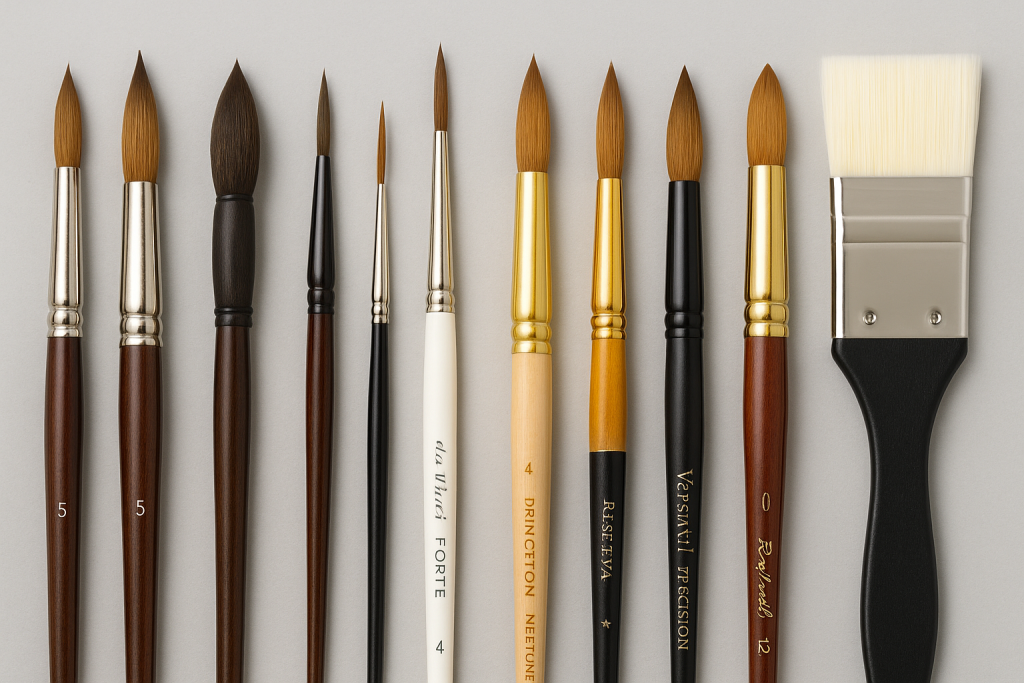
As a realist watercolorist, your brush is more than a tool — it’s an extension of your hand, your intention, and your control over the medium’s wild nature. Choosing the right brush can elevate your technique, improve control, and dramatically influence how pigment dances across the page.
So let’s dive into the world of watercolor brushes, comparing synthetic vs sable, exploring different brush types, and reviewing trusted brands like Escoda, Princeton, Da Vinci, and more.
🧬 Sable vs Synthetic Brushes: What’s the Difference?
🦊 Sable Brushes (Often Kolinsky)
Natural hair from the tail of the Siberian weasel (no, not an actual sable).
Known for:
Incredible water retention
Snap & spring (returns to a point beautifully)
Smooth pigment flow
Durability if cared for properly
🔥 Ideal for: detailed work, long washes, expressive calligraphic strokes
🧪 Synthetic Brushes
Made from nylon or polyester filaments (often dyed or textured to mimic natural hair).
Pros:
Budget-friendly
Vegan-friendly
Great for fine details or lifting techniques
Cons:
Typically hold less water
May wear out faster or lose point over time
Newer “hybrid” synthetics (like Escoda Versatil or Princeton Neptune) are seriously impressive.
🔄 Quick Comparison Chart
| Feature | Sable | Synthetic |
|---|---|---|
| Water holding | ⭐⭐⭐⭐⭐ | ⭐⭐–⭐⭐⭐ |
| Point retention | ⭐⭐⭐⭐⭐ | ⭐⭐–⭐⭐⭐ |
| Price | 💸💸💸💸💸 | 💸💸💸 |
| Animal-free | ❌ | ✅ |
| Durability | High (with care) | Moderate |
🔍 Brush Shapes for Watercolor & What They Do
🔵 Round (the workhorse)
Tapered, pointed tip — perfect for everything from fine lines to broad strokes.
Use for: layering, glazing, edge control, and detail
✅ Recommended:
Escoda Reserva (Kolinsky Sable)
Princeton Heritage 4050 (Synthetic)
✒️ Rigger (liner)
Long, thin brush with a fine point.
Originally used for painting ship rigging!
Use for: long continuous lines, fine details, hairlines, branches
✅ Recommended:
Da Vinci Maestro rigger
Princeton Velvetouch or Neptune for synthetic option
🟫 Flat / One Stroke
Flat edge; great for washes, bold blocking, or sharp edges.
Use for: backgrounds, angular forms, architectural elements
✅ Recommended:
Raphaël Precision Flat (Synthetic)
Escoda Ultimo Flat
🖤 Mop / Quill
Round and fluffy — perfect for big, juicy washes and laying down color fast.
Sable or squirrel preferred, but synthetics are catching up.
✅ Recommended:
Da Vinci Casaneo Mop (synthetic squirrel)
Escoda Aquario (natural squirrel)
🏆 Top Brush Brands for Watercolor
🖌️ Escoda (Spain)
Famous for Reserva (Kolinsky), Versatil (synthetic), and Ultimo (synthetic squirrel).
Handcrafted, triple-crimped ferrules, great durability.
🖌️ Da Vinci (Germany)
Their Maestro (Kolinsky) and Cosmotop Spin (synthetic) lines are studio staples.
Great water retention, excellent balance.
🖌️ Princeton (USA)
Known for affordability and innovation in synthetics.
Heritage 4050, Neptune, and Velvetouch lines are highly respected.
🖌️ Raphaël (France)
Offers the Kolinsky 8404 (legendary in detail work) and Precision synthetic series.
Squirrel hair lines like Soft Aqua are beloved for mops.
🧼 Care Tips (Especially for Sable)
Don’t let paint dry in the brush.
Gently clean with mild soap (e.g., Masters Brush Cleaner).
Never store tip-down or wet in a closed container.
Restoring the point after rinsing = brush longevity.
🧠 Final Thoughts
In a world increasingly full of high-performance synthetics, traditional sable brushes still reign supreme for control and water handling. But today’s top-tier synthetics offer 90% of the feel at a fraction of the cost — especially for beginners or travel kits.
Your ideal brush set? A hybrid:
1–2 sable rounds for fine control and layering
A few synthetic flats and riggers for versatility
A synthetic mop or squirrel for juicy washes
🎨 The best brush is the one you reach for without thinking. And when it vanishes into your hand, you know you’ve found your tool.
