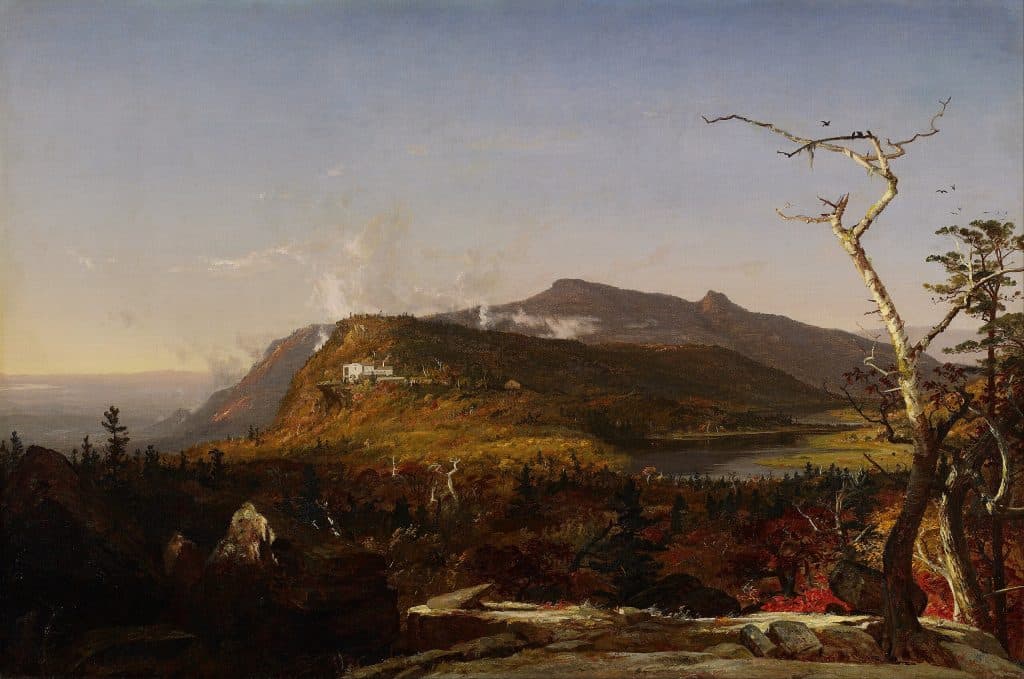
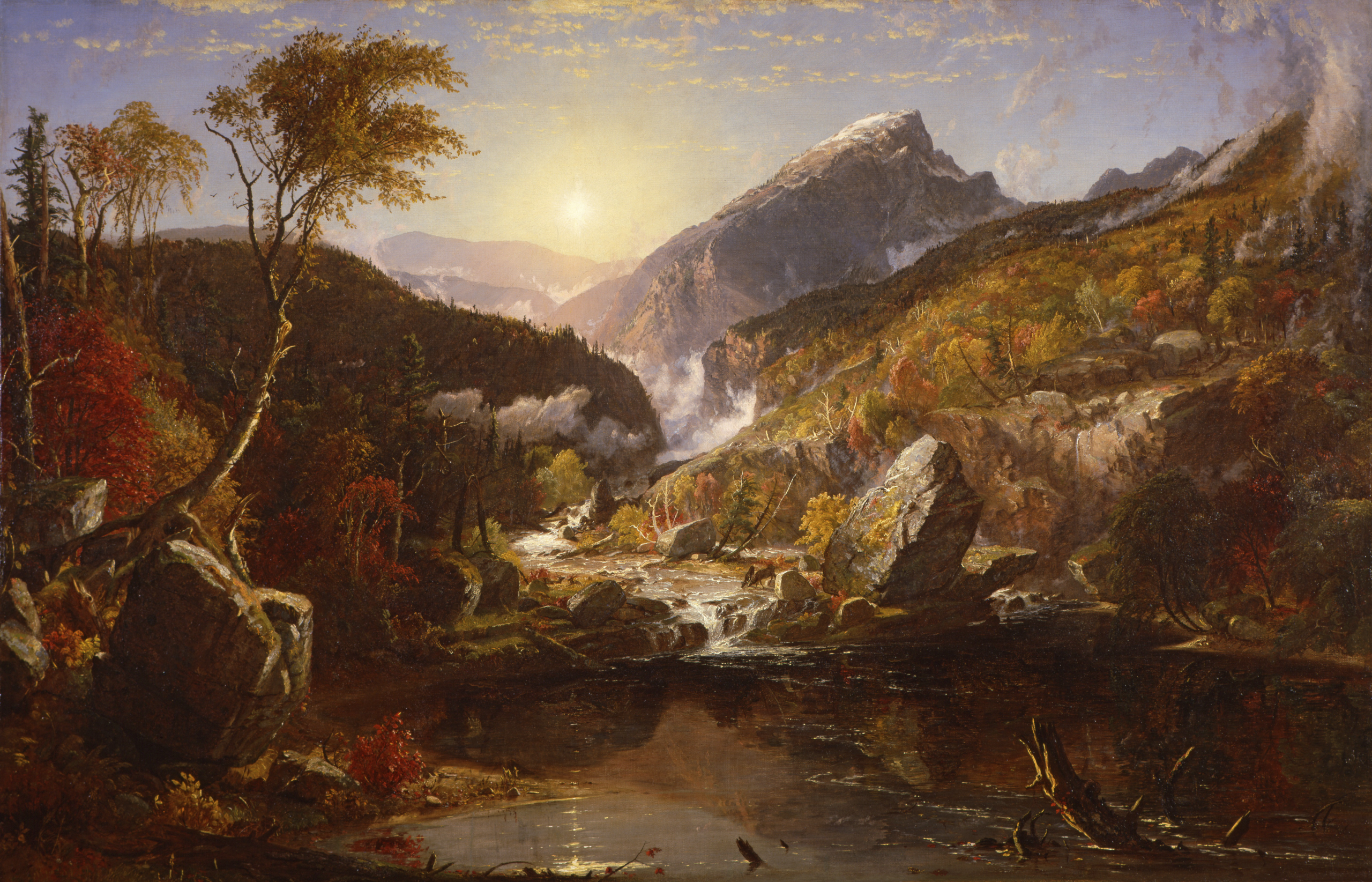

Jasper Francis Cropsey (1823–1900) stands as one of the most distinctive voices of the Hudson River School. Where Thomas Cole framed wilderness as a moral stage and Frederic Church delivered sweeping theatrical grandeur, Cropsey carved out a quieter, more architectural poetry—rooted in structure, clarity, and seasonal radiance. He became, almost accidentally, the great painter of the American autumn.
Born on Staten Island and trained first as an architect, Cropsey never entirely shed the precision that discipline instilled in him. His drawings reveal a mind accustomed to measuring the world before describing it, and his landscapes reflect that same sentiment: foregrounds built like foundations, middle distances unfolding with deliberate rhythm, and skies that settle onto the land the way a vaulted ceiling rests on its arches. Even in his loosest brushwork, structure is never far away.
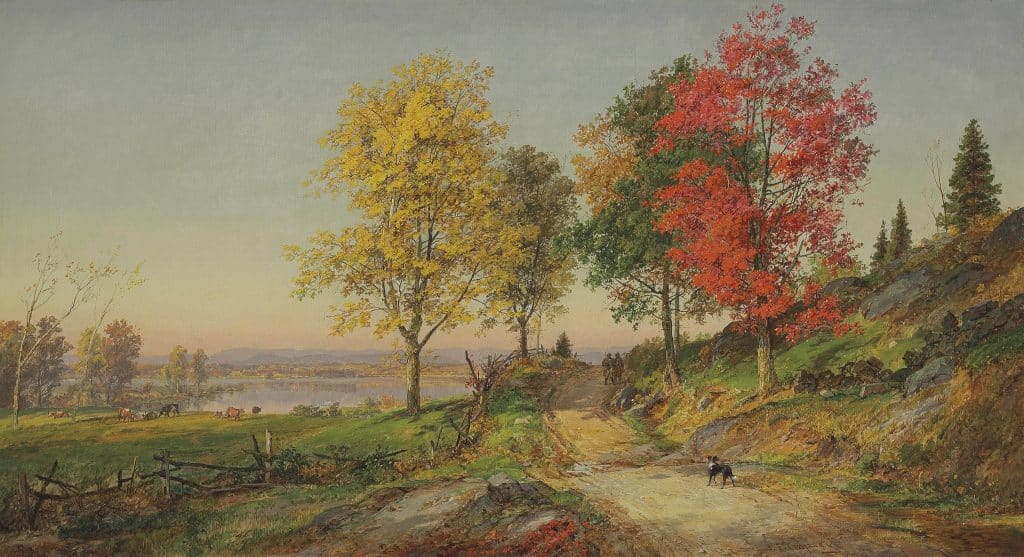
What captivated him most, however, was the transformation of the seasons. While many Hudson River painters celebrated lofty mountains and unspoiled forests, Cropsey found drama in the annual turning of leaves, when the hills of the Northeast blazed with russet, gold, and fire. His autumns are not merely decorative—they pulse with a sense of momentary glory, the brief burning of the year before winter’s quiet takes hold. Contemporary viewers sometimes accused him of exaggeration, but Cropsey defended his palette with a simple truth: American autumn is that vivid, and he intended to honor it.
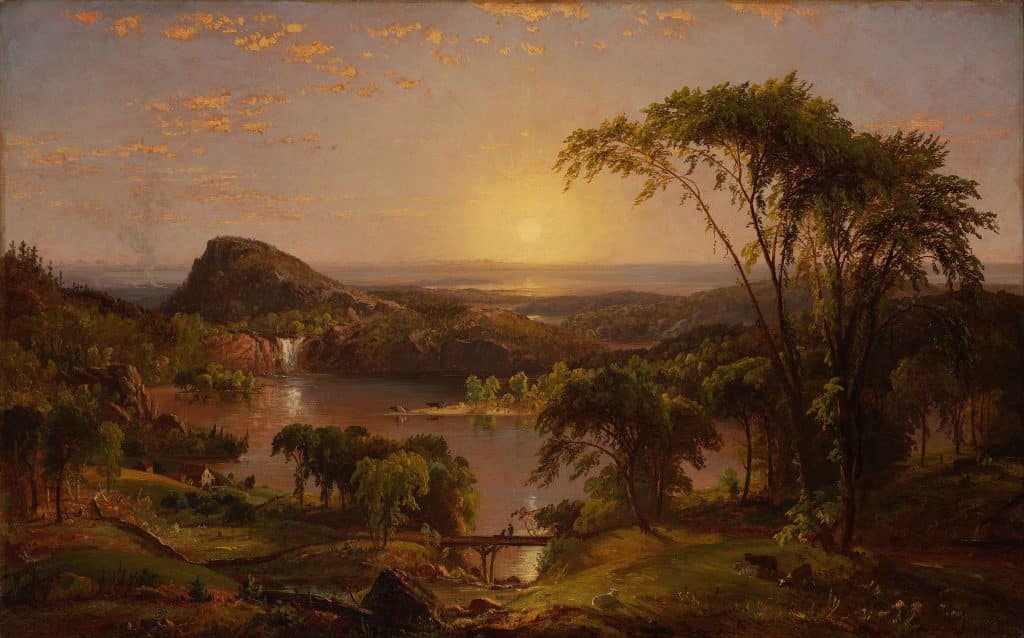
Travel shaped him as well. His years in England sharpened his sense of atmosphere and distance, and his European paintings show a refined handling of diffused light. Yet he never lost his American sensibility. The clarity of his skies, the crispness of his forms, and the almost architectural order of his compositions remained unmistakably his own.
Cropsey’s work invites a lingering gaze. Look long enough and the scene begins to breathe—leaves flicker, mist lifts, rivers wind toward a horizon drawn with a surveyor’s exactness. In his paintings, nature is both measured and alive, both constructed and freely given. It is this union of discipline and lyricism that makes Cropsey such an essential figure within the Hudson River tradition.
Today, his legacy continues through the preservation of his home and studio, Ever Rest, in Hastings-on-Hudson. Standing in that space, surrounded by autumn paintings that seem to glow even in winter’s light, one senses an artist who understood the landscape not as spectacle, but as a place of renewal, memory, and quiet wonder.
To look at a Cropsey painting is to feel the year turning beneath your feet—deliberate, radiant, and fleeting.