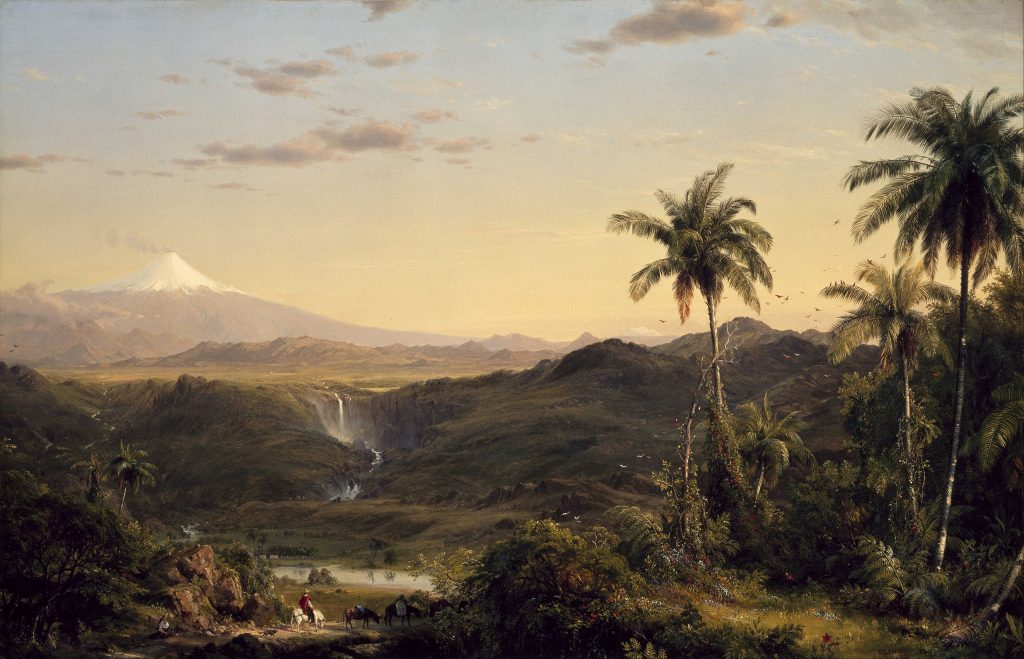
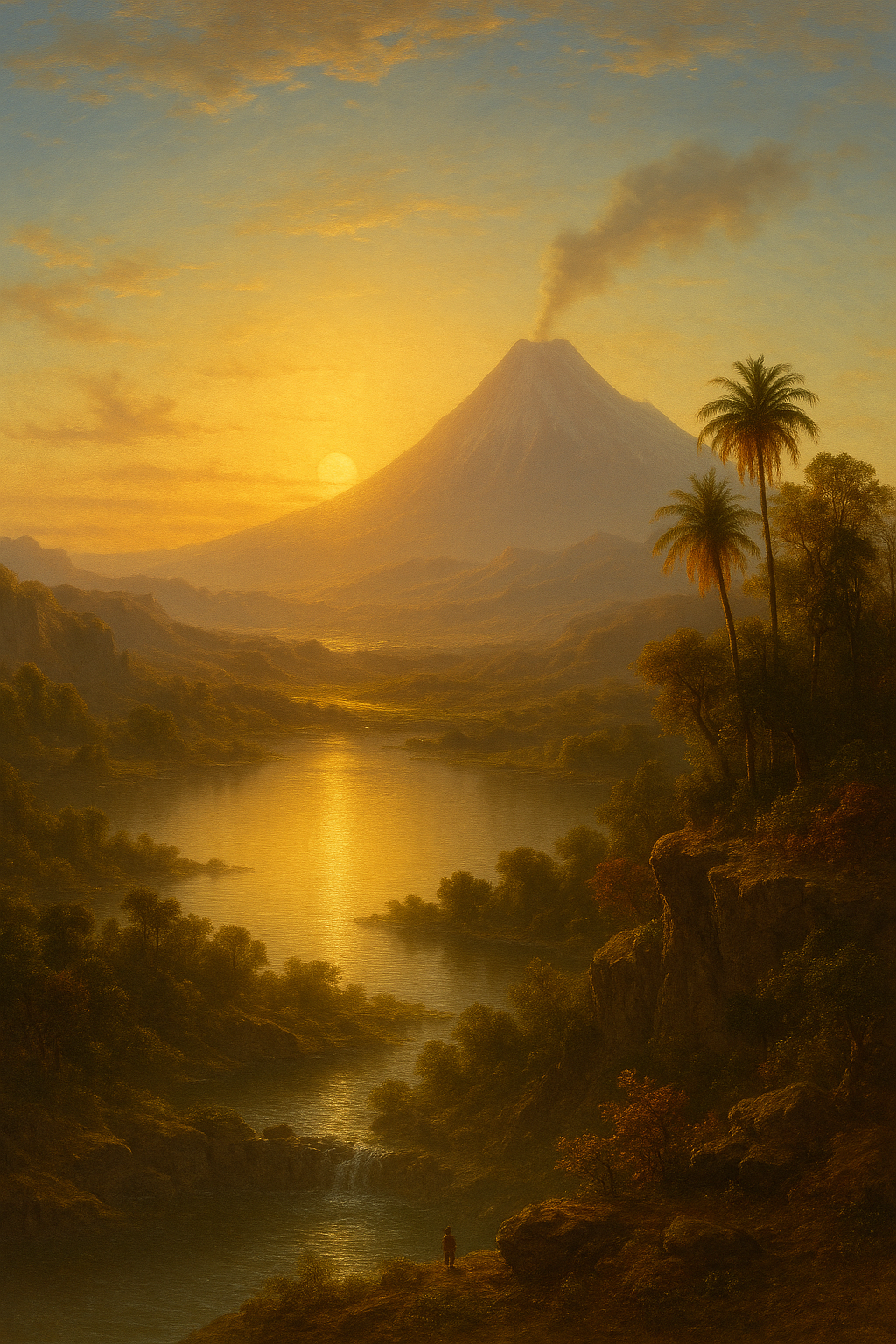

If the Hudson River School had a virtuoso, a painter whose ambition stretched as wide as his canvases, it was Frederic Edwin Church. Where Thomas Cole offered philosophy and Asher Durand offered intimacy, Church offered something else entirely:
spectacle with purpose.
He didn’t merely paint landscapes — he painted epics: volcanoes glowing like open furnaces, icebergs towering like frozen cathedrals, jungles alive with humidity and light. His work feels like the visual equivalent of a symphony that fills the room and leaves no corner untouched.
Apprentice to the Master
Church was the only formal student of Thomas Cole, and he inherited his mentor’s love for symbolism — but not his restraint. Cole painted to express ideas; Church painted to reveal the world.
He was born with an explorer’s heart, and his art became a ticket to the edges of the earth.
A Painter With a Passport
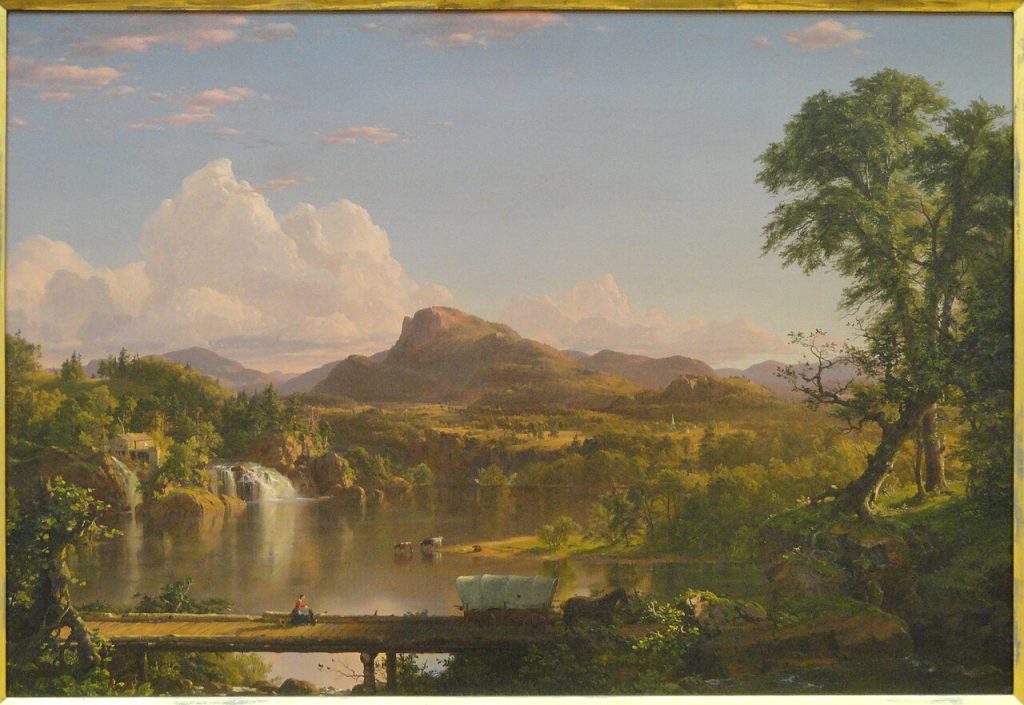
Where other Hudson River painters stayed mainly in the Northeast, Church embraced travel as part of the creative process. Guided by scientific curiosity and a desire to witness creation in all its majesty, he traveled to:
- the Andes of South America
- the Middle East
- the Arctic
- the American West
- the Caribbean
He arrived home with sketchbooks packed with studies of palm trees, snowfields, basalt cliffs, volcanic ash, equatorial sunlight, tropical cloud formations — all raw material for the grand canvases that would follow.
Church didn’t just see the world.
He gathered it.
The Luminist Scientist
Church was a meticulous observer. His paintings show a fascination with:
- atmospheric layers
- how light behaves at different altitudes
- geological formations
- precise botany
- meteorological drama
He studied nature almost the way a scientist studies specimens — with accuracy, patience, and delight.
This precision is what gives works like The Heart of the Andes their astonishing realism. You feel like you could step into the painting and walk for miles without losing detail.
When Paintings Became Events
Church’s exhibitions were legendary. Viewers paid admission to stand before canvases so large and so luminous that they felt like windows onto another world.
Some of these shows had:
- velvet curtains
- theatrical lighting
- pamphlets explaining the geography
- crowds lined around the block
Imagine a single painting drawing thousands of people. That was Church’s world.
Masterpieces That Still Stop Us Cold
• The Heart of the Andes (1859)
A panoramic sweep of South American landscape so detailed it took a special platform to view it properly. It was the 19th-century equivalent of a world tour in a single frame.
• Niagara (1857)
A rushing, thundering force of nature almost overwhelming in scale — wet, misty, alive.
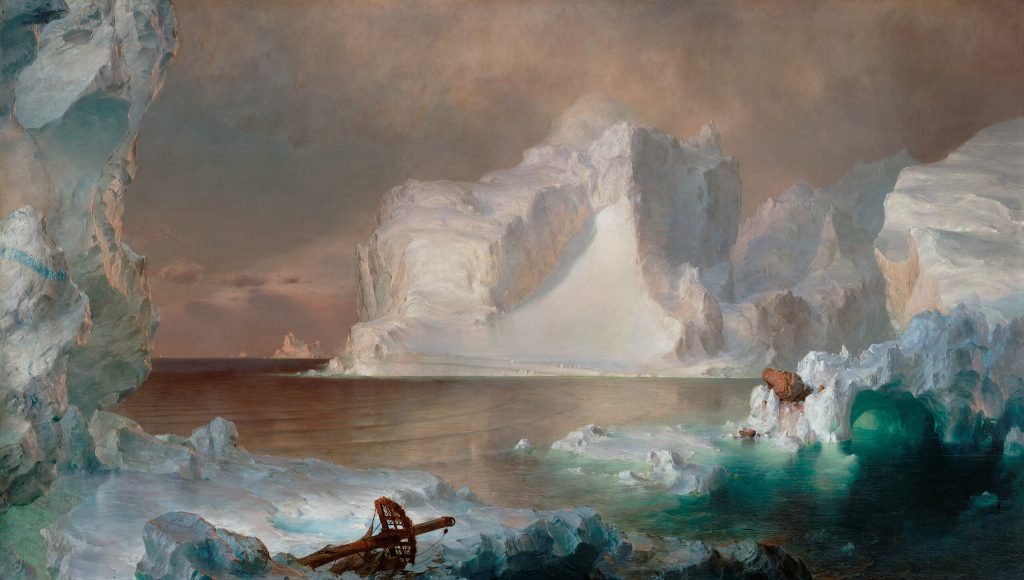
• The Icebergs (1861)
A vision of the Arctic as both breathtaking and terrifying. Church used color sparingly here, letting ice and shadow do the storytelling.
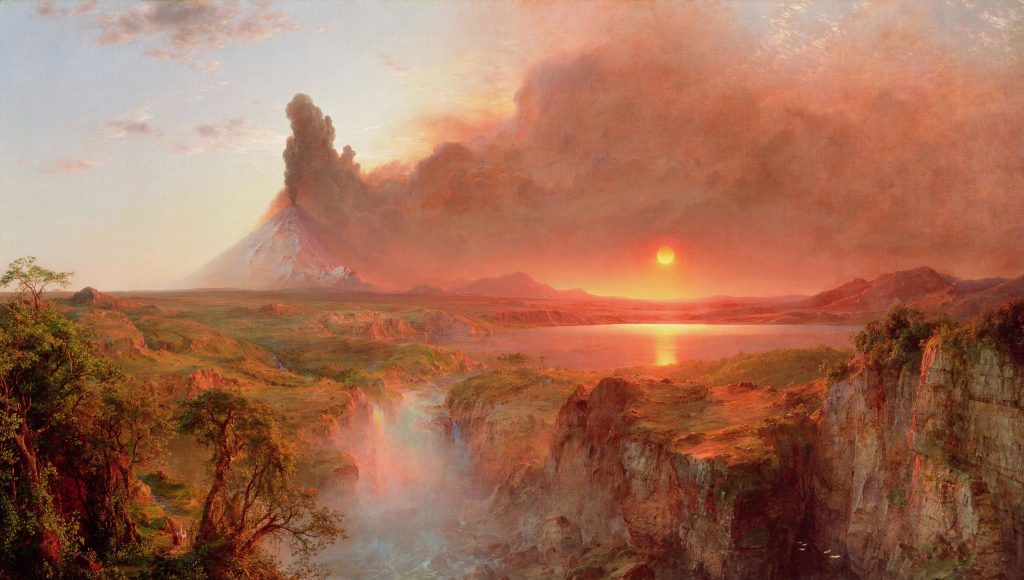
• Cotopaxi (1862)
A volcanic eruption rendered with such molten force that the painting seems lit from within.
Olana: The Artist Builds His Own Vision
Church’s final masterpiece wasn’t a painting — it was Olana, his home overlooking the Hudson River.
A Persian-inspired villa with sweeping views and gardens he designed himself.
It remains one of the most unique artist-built homes in America, a place where architecture, landscape, and light harmonize exactly the way he intended.
Church’s Legacy: Awe, Wonder, and Precision
To stand before a Church canvas is to feel something ancient stir — that combination of reverence and curiosity we feel at the edge of great natural beauty.
He reminds us that the world is vast, luminous, and worth exploring.
And that art, when rooted in truth and vision, can be both a map and a revelation.