
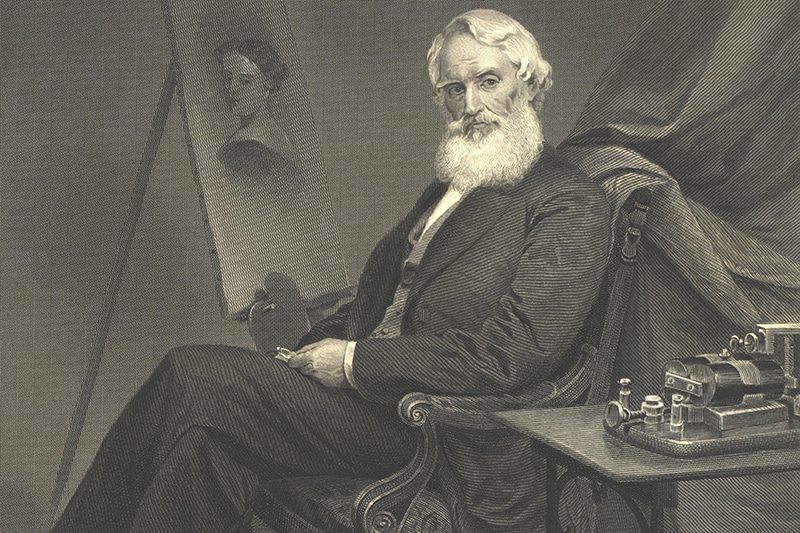

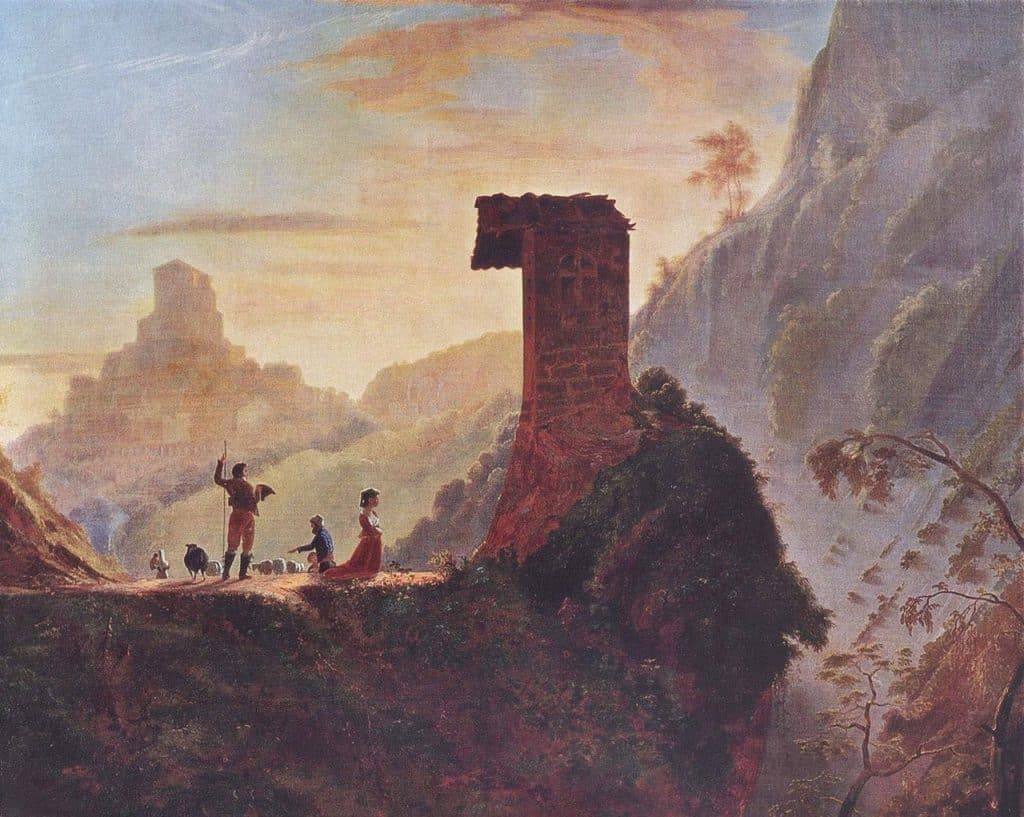
The Artist Before the Inventor
Before electricity ever pulsed across his wires, Morse devoted decades to painting. Trained at Yale and then under Washington Allston, he embraced the Romantic spirit of the early 19th century. His brushwork tended toward the dramatic: strong contrasts, moral intensity, and carefully controlled value structures.
He traveled to Europe in 1811, absorbing the structured realism of continental academies. Here, Morse became enamored with the old masters — their composition, their narrative power, and their ability to orchestrate light as if conducting a symphony.
His ambition crystallized in a single monumental project.
“Gallery of the Louvre”: Morse’s Magnum Opus
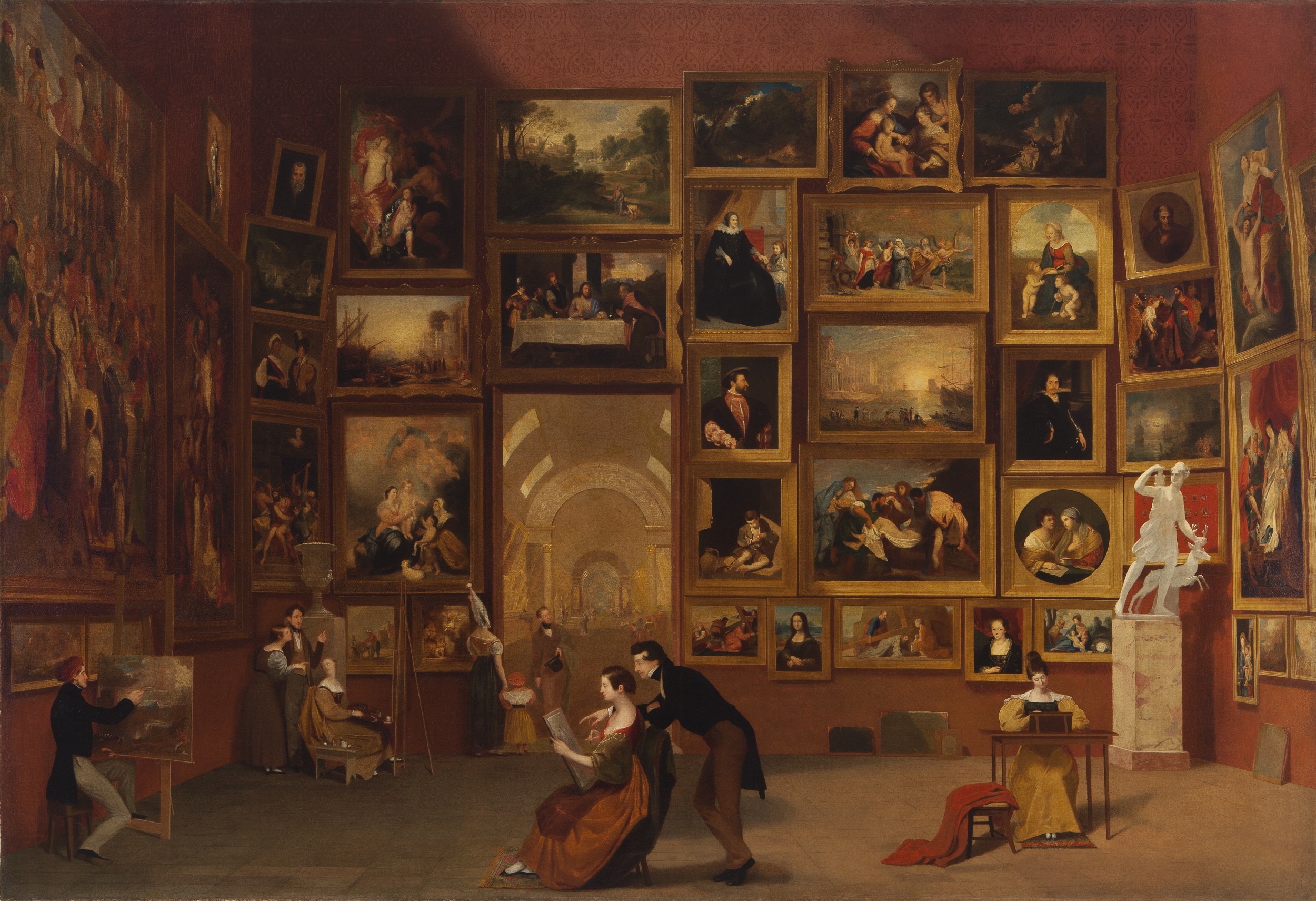
Imagine a young American painter standing in the Louvre, overwhelmed by its treasures… and deciding to paint them all into a single grand canvas. That’s Morse.
Gallery of the Louvre (1831–33) is both an artwork and an argument: an argument that American painters could rise to the level of Europe’s great academies if given proper instruction and exposure. Morse spent months copying masterpieces, arranging them in a tight, choreographed composition where line, gesture, and value quietly guide the eye.
In many ways, the painting reveals Morse’s artistic philosophy:
- Art as education — paintings teaching through their presence
- Light as architecture — clean, directional illumination guiding form
- Structure over spontaneity — a disciplined approach that echoes his later engineering mindset
It is a painter’s love letter to the canon — and a teacher’s gift to future American artists.
The Turning Point: Grief and Innovation
Morse’s life as an artist shifted dramatically in 1825 when he was painting a portrait in Washington. He received a letter telling him his wife was gravely ill. By the time he returned to New Haven, she had already died. He hadn’t even known she was sick.
That missed moment — that silence over distance — hollowed him.
This grief eventually led him toward a question:
Could communication travel faster than a horse? Could it be instantaneous?
Morse didn’t abandon art overnight, but the pivot was deep. The disciplined mind that once orchestrated Louvre masterpieces now bent toward wire, magnetism, and signal.
And soon, lightning found a language.
The Telegraph: Artful Logic Made Visible
Most people think of the telegraph as a purely technical achievement. But Morse approached it like an artist:
- Clarity of design
- Elegance of line and form (literally, along a wire)
- A symbolic language distilled to essential marks
Morse Code is, in its way, a kind of minimalistic drawing — a reduction of language into dots and dashes, rhythm and spacing. His engineering triumph came from the same mind that once structured complex canvases.
Artists, after all, understand how to turn the invisible into the visible.
A Legacy in Two Worlds
Few historical figures straddle disciplines the way Morse does. His impact in both arenas is enormous:
- In art, he helped establish the National Academy of Design and championed American painting during its formative decades.
- In technology, he accelerated global communication and reshaped the modern world.
Though the telegraph ultimately eclipsed his painting career, it never erased it. Today, Gallery of the Louvre stands as a testament to his artistic ambition — a reminder that creativity often defies boundaries.
For artists, Morse is proof that the same mind capable of shaping beauty on canvas can also reshape the world beyond it.
