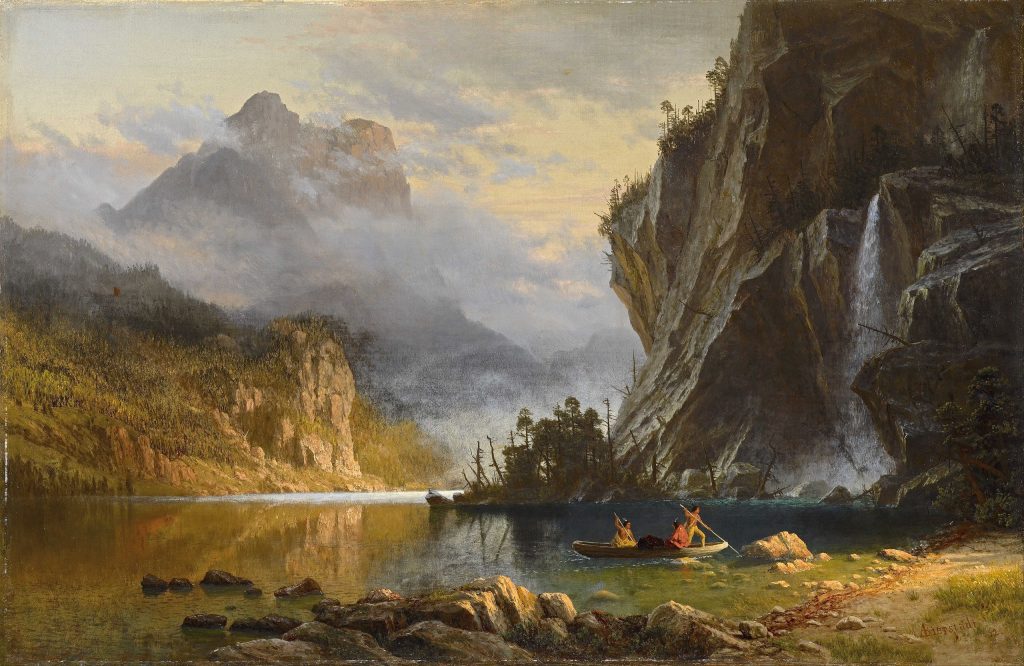
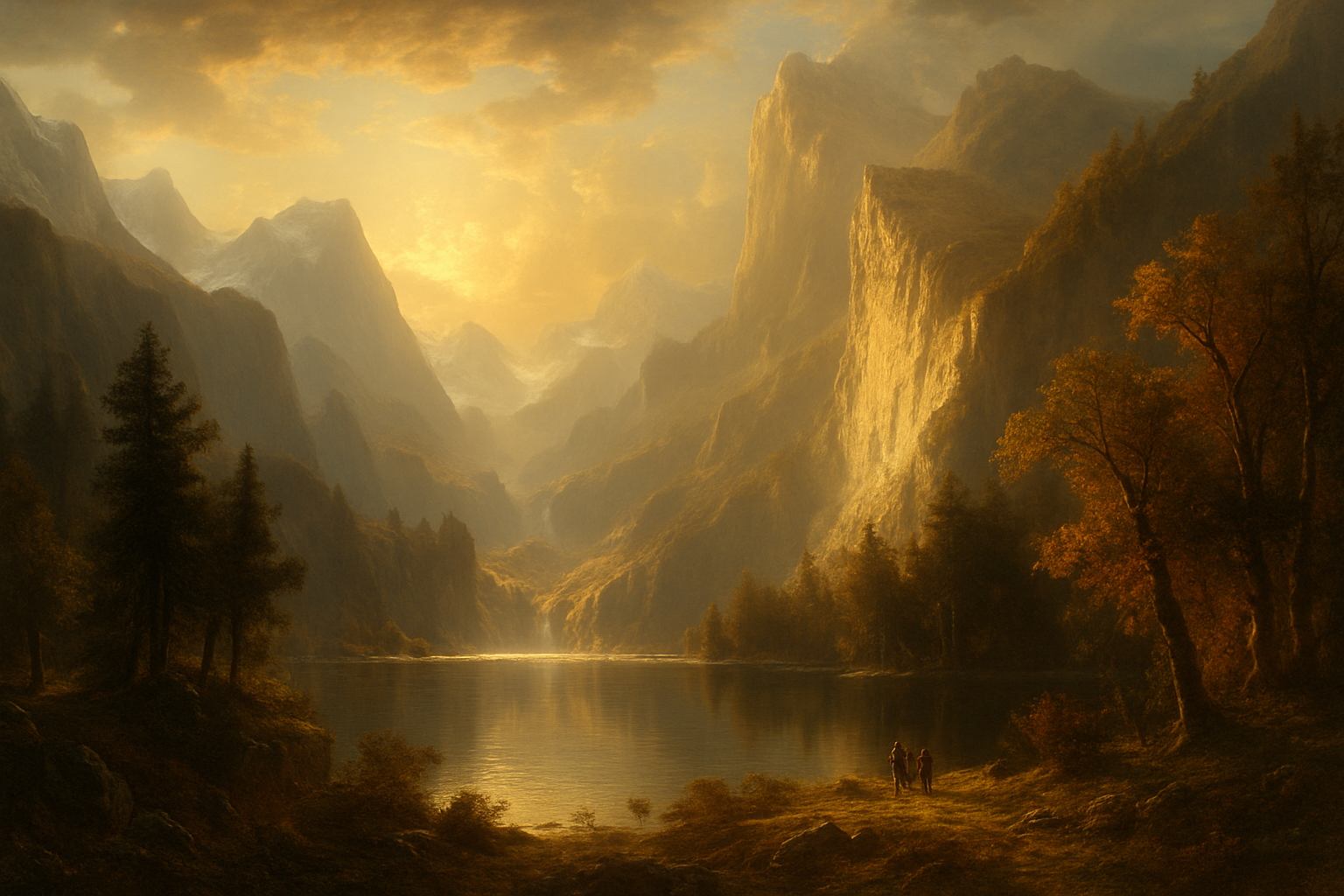

Some painters whisper. Some reflect quietly. And then there’s Albert Bierstadt, who steps onto the stage with the confidence of “Let there be light” and paints landscapes so vast you feel like you’re stepping into another world.
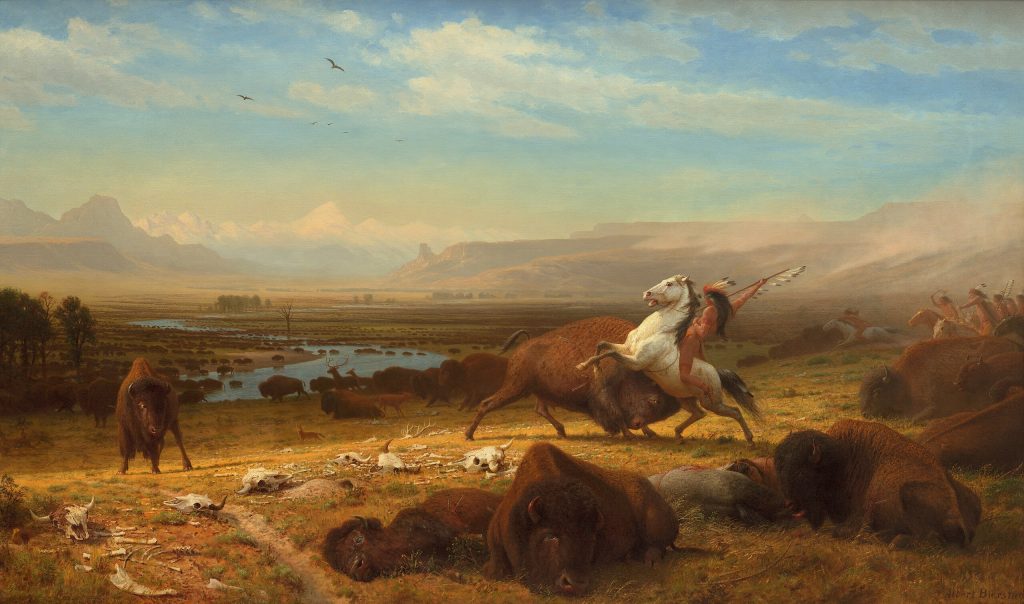
If Asher Durand was the poet of the forest interior and Thomas Cole the philosopher, Bierstadt was the cinematographer before cinema existed — the artist who made the American West look like a divine revelation. His canvases didn’t just depict mountains; they glorified them. He wanted viewers to feel small, humbled, and awestruck.
And judging by the crowds he drew, it worked.
From the Alps to the Rockies
Bierstadt was born in Germany but raised in New England. His earliest inspiration came from the European Alps, and that sense of scale became the backbone of his later Western scenes. When he joined government survey teams heading into the Rocky Mountains and Yosemite Valley, he carried with him both ambition and an eye trained to see mountains as monumental.
He wasn’t simply painting the West — he was introducing it to an East Coast audience who had never imagined scenery this grand.
The Theatrical Touch
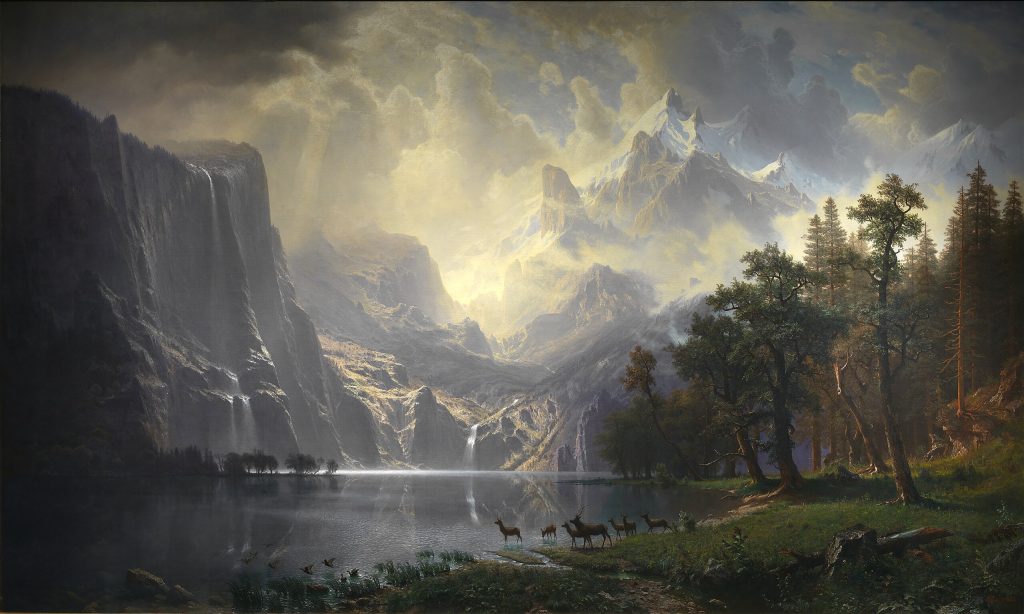
Bierstadt’s technique was bold, almost operatic:
-
- high-contrast light
-
- sweeping perspectives
-
- clouds piled high like cathedral domes
-
- mist used as a softening veil
-
- glowing sunsets that bathed whole valleys in gold
He often staged his exhibitions like theatrical performances. Giant canvases hung in darkened rooms, lit dramatically, sometimes accompanied by opera music. It was part art, part spectacle — and early Americans couldn’t get enough.
There was a reason his work was described as the IMAX of the 19th century.
Yosemite: His Great Muse
If Bierstadt had a spiritual home, it was Yosemite Valley. His paintings of its soaring granite walls, still lakes, and atmospheric mists became icons. At a time when photography was still primitive, his canvases were windows into a world that few easterners had ever seen.
Paintings like Looking Down Yosemite Valley or Valley of the Yosemite became catalysts for something much bigger:
they helped inspire early conservation movements and eventually contributed to the formation of the national park system.
Bierstadt painted nature not just as landscape, but as inheritance.
Technique: The Grandeur Formula
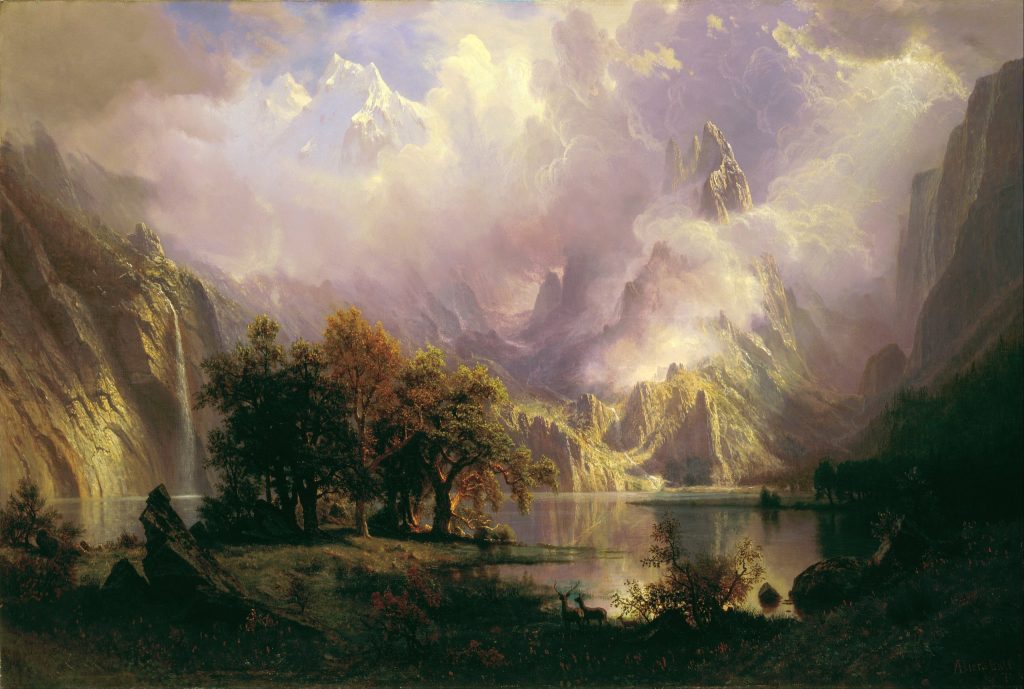
Bierstadt’s distinctive look comes from a specific approach:
- Field studies — small oil sketches done rapidly on site
- Studio recomposition — merging multiple views into a perfected, idealized scene
- Layering — transparent glazes over solid forms to create luminous effects
- Atmospheric progression — warm light in the foreground, cooler tones in the distance
- Tiny figures or wildlife — to emphasize the immensity of nature
He wasn’t a strict realist; he was an idealizer. He wanted not the West as it was, but the West as it felt.
The Spectacle Fades… and Rises Again
As tastes shifted toward realism and Impressionism, Bierstadt’s fame dimmed. Critics called him melodramatic and overly romantic. But time has a sense of humor: today, his work commands renewed admiration for its technical mastery, historical significance, and breathtaking vision.
Bierstadt’s paintings remind us of something essential — that the landscape can still overwhelm us, still quiet us, still lift our eyes upward.
Why Bierstadt Matters Today
In a world full of speed and screens, Bierstadt’s art is an invitation to pause and look up.
His mountains rise like hymns.
His light feels like revelation.
His compositions make the heart open a little wider.
He didn’t just show us the West — he made it feel eternal.