
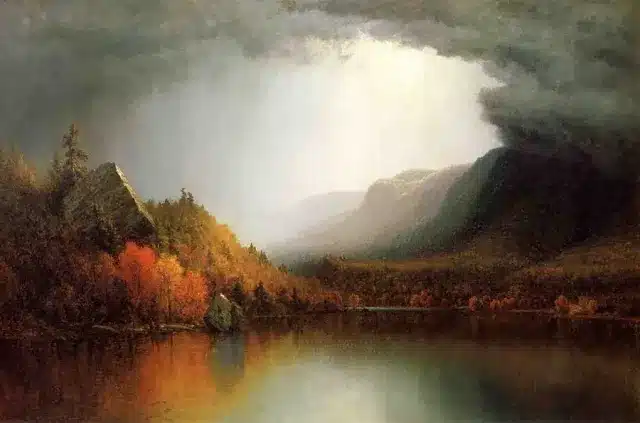

Sanford Robinson Gifford (1823–1880) stands as one of the quiet geniuses of the Hudson River School—an artist whose brush didn’t shout, but glowed. While some of his contemporaries reveled in dramatic cliffs, grand canyons, and thundering skies, Gifford chose to whisper with light. His landscapes seem to exhale. They inhabit that tender space between realism and dream, where the world softens into luminous stillness.
A Life Formed by Wanderlust and Observation
Born in Greenfield, New York, Gifford didn’t begin as a painter; he began as a curious observer. After leaving Brown University to pursue art, he immersed himself in study at the National Academy of Design. But it was travel—through the Hudson River Valley, across the Catskills, around the Adirondacks, and later throughout Europe and the Middle East—that shaped his mature vision.
Wherever he went, he carried a sketchbook. Those field notes became the foundation for the serene, glowing works that would define his career.
The Essence of “Luminism”
Gifford’s work is often placed under the branch of the Hudson River School known as Luminism, a term that suits him more than almost anyone else in the movement.
His paintings share three traits:
1. A glowing, atmospheric light
Gifford’s skies are delicate veils of gold and amber. Light becomes a presence—almost a theology—permeating everything it touches. His paintings whisper of eternity rather than spectacle.
2. Glass-smooth water and serene horizons
The water in his work reflects like a polished mirror, giving his landscapes a contemplative, meditative stillness.
3. A sense of spiritual quiet
Even when Gifford painted vast scenes, he did so with restraint. There is little agitation. Instead, everything settles into peaceful equilibrium.
Where Thomas Cole dramatized, and Frederic Church dazzled, Gifford calmed.
Notable Works to Explore
Here are a few touchstone pieces that reveal his craft at full maturity:
- “Kaaterskill Falls” (1871) – A glowing interpretation of one of America’s iconic cascades.
- “A Lake Twilight” (1861) – An atmospheric harmony of gold, violet, and silver.
- “Ruins of the Parthenon” (1869) – Showing how his luminism translated to classical landscapes.
- “Mount Merino — Sunset” (1861–62) – A glowing Hudson Valley masterpiece.
Each work demonstrates his unusual precision in handling light, where edges soften and land dissolves gently into sky.
Technique: The Art of Stillness
Gifford was a master of tonal control. Instead of punchy contrasts or impasto, he preferred:
- Thin, even layers of oil paint
- Subtle gradations of warm to cool hues
- Delicate atmospheric perspective
- Clear, nearly invisible brushwork
This gave his paintings their “luminous hush.” Painters today often study his skies and water passages as perfect examples of how to suggest distance, air, and time itself.
Why Gifford Still Matters
In an age overflowing with visual noise, Gifford’s paintings offer the opposite: quiet contemplation. They remind us that beauty can be found not only in dramatic gestures, but in whispered ones.
His landscapes function like visual prayers—peaceful, meditative, and suffused with a clarity that feels almost sacred. For artists, his work serves as a masterclass in atmosphere; for historians, a window into 19th-century American idealism; and for viewers, a moment of calm.
